
Preventing Calcium Sulfate Scale in Kazakhstan Boiler Feedwater RO: Antiscalant Selection Beyond LSI
Industrial facilities in Kazakhstan increasingly rely on reverse osmosis (RO) to produce low-mineral water for boilers, district heating systems, power plants, refineries, mining facilities, and manufacturing operations. In many regions, brackish groundwater is the most available source. Yet this water frequently contains elevated sulfate, calcium, magnesium, barium, and strontium.
For boiler feedwater treatment, RO performance is critical. A reduction in membrane flow, increase in differential pressure, or decline in salt rejection can affect downstream demineralization capacity and disrupt steam production. One of the most common design mistakes is evaluating RO scaling risk using only the Langelier Saturation Index (LSI).
LSI is useful for assessing calcium carbonate tendency. But it does not predict gypsum, barium sulfate, or strontium sulfate precipitation. In high-sulfate Kazakh groundwater, a system may show low calcium carbonate scaling risk while still experiencing severe inorganic fouling from calcium sulfate.
The solution is a broader scaling assessment, proper RO membrane antiscalant selection, and concentrated-brine modeling that accounts for all critical mineral species.
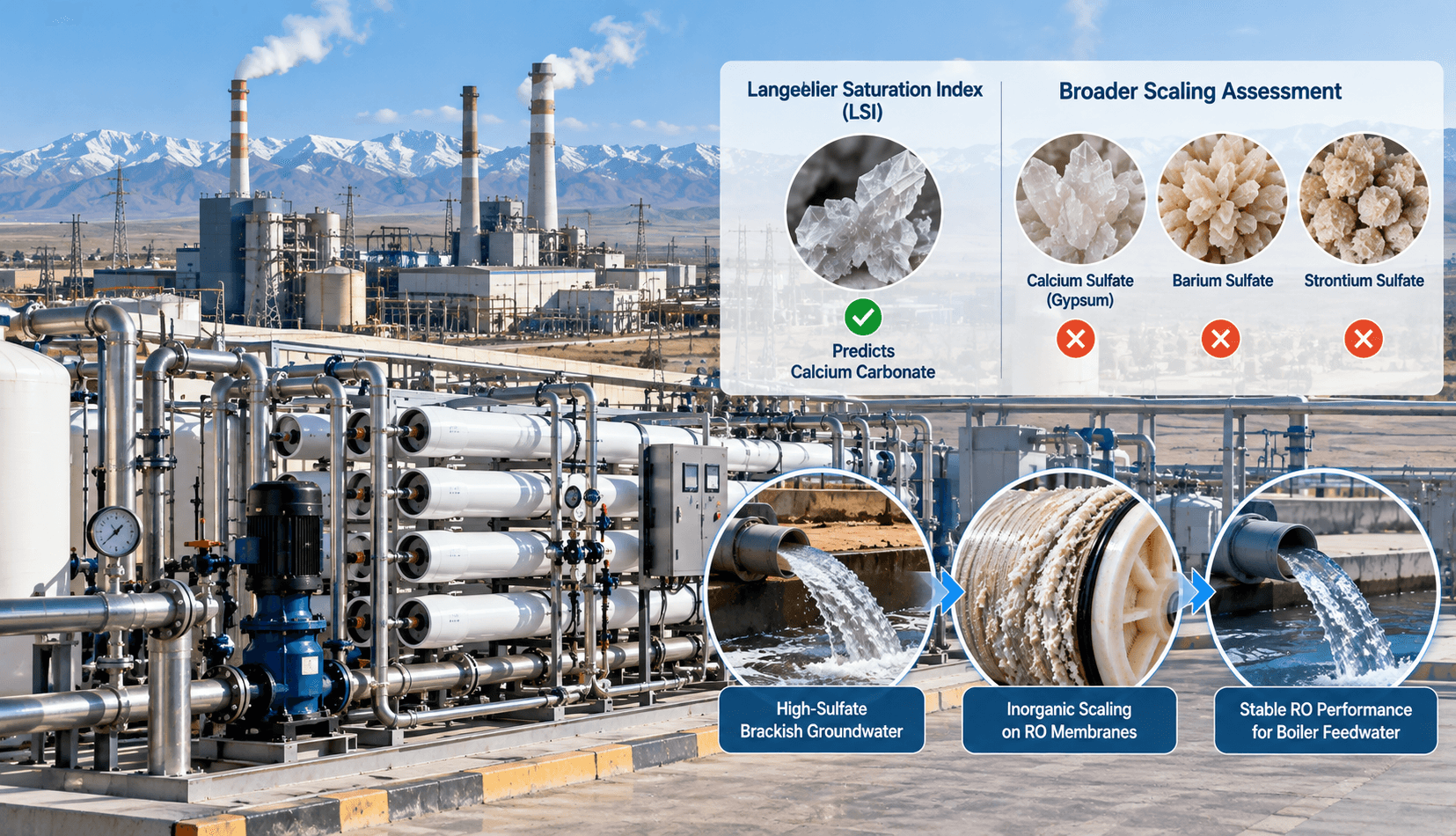
Why Boiler Feedwater RO Cannot Rely Only on LSI
The Langelier Saturation Index estimates whether water is likely to precipitate or dissolve calcium carbonate. It is based on parameters such as pH, alkalinity, calcium concentration, TDS, and temperature.
For conventional groundwater treatment, LSI can help indicate whether calcium carbonate scale may form. However, boiler feedwater RO systems often process water where sulfate rather than alkalinity is the dominant scaling concern.
A low or negative LSI may falsely suggest that the RO system is safe from scale. In reality, calcium and sulfate ions become increasingly concentrated as water passes through an RO membrane array. At the membrane surface and in the concentrate channel, the concentration can exceed the solubility limit of calcium sulfate dihydrate, commonly known as gypsum.
This makes relying on LSI alone dangerous for boiler feedwater treatment Kazakhstan projects. RO design must consider saturation indices and solubility limits for multiple minerals, especially:
- Calcium carbonate: CaCO3
- Calcium sulfate dihydrate: CaSO4⋅2H2O
- Barium sulfate: BaSO4
- Strontium sulfate: SrSO4
- Calcium phosphate
- Silica and metal-silicate deposits, where relevant
Calcium Sulfate, Barium Sulfate, and Strontium Sulfate: Different Risks, Different Consequences
Calcium Sulfate: The Gypsum Scale Problem
Calcium sulfate scale is particularly problematic because it can form in brackish RO systems even at relatively moderate pH. Unlike calcium carbonate, gypsum precipitation is not effectively controlled simply by acid dosing or pH reduction.
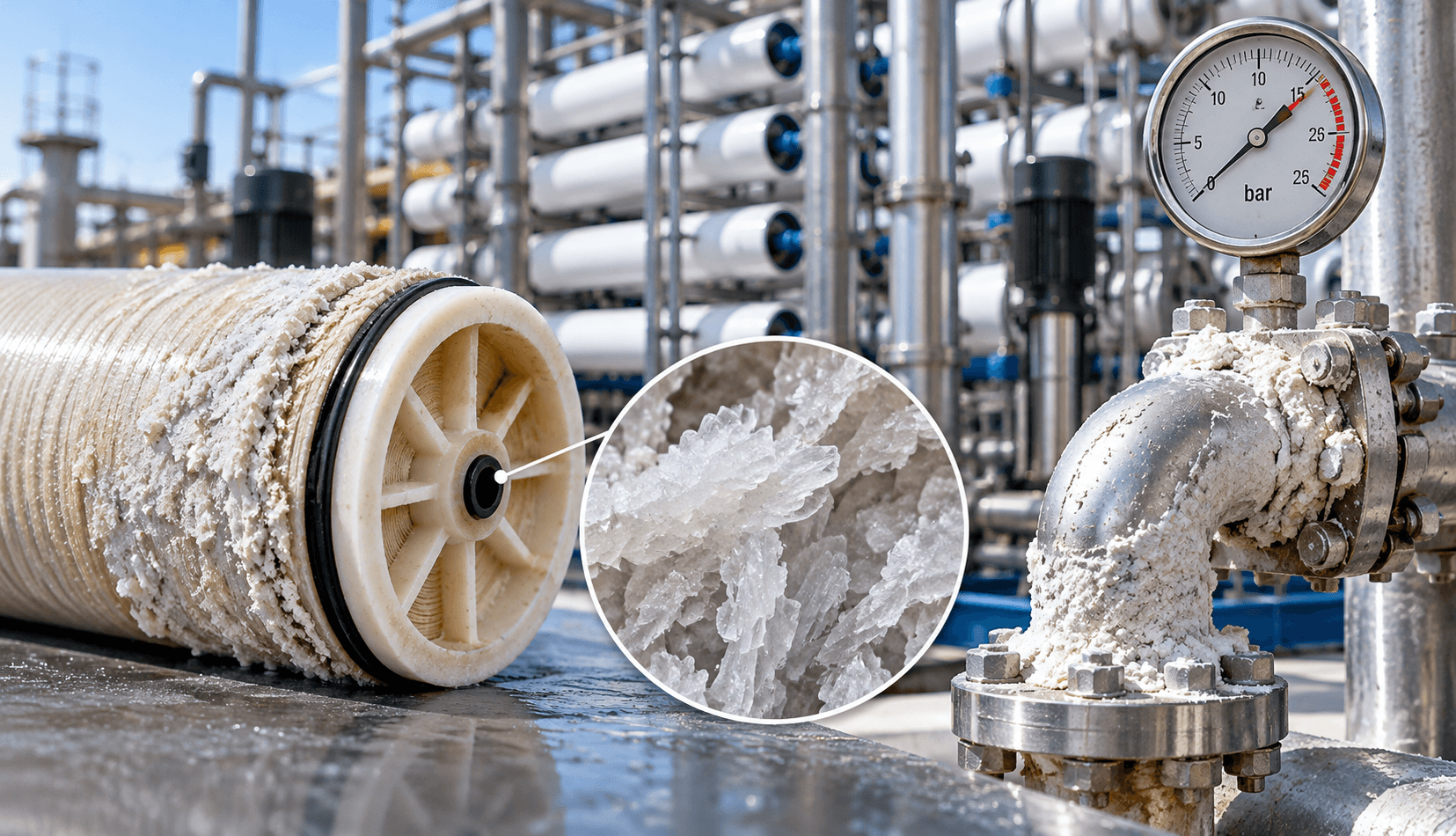
Gypsum scale typically appears as a hard, white or off-white deposit. It can form on membrane surfaces, feed spacers, pressure vessels, and concentrate piping. Once established, it reduces permeate flow and increases pressure losses.
The risk rises when feedwater contains both high calcium and high sulfate and the system operates at a high recovery rate. This is the classic challenge of gypsum scale in RO systems.
Barium Sulfate: Low Solubility, High Impact
Barium sulfate is much less soluble than calcium sulfate. Even trace concentrations of barium can cause severe scaling if sulfate is present. Barium sulfate deposits are extremely difficult to dissolve with conventional acid cleaning.
Because barium is often not included in basic water analyses, it may be missed during the initial RO design stage. For high-sulfate groundwater, barium testing should be included before setting recovery targets and selecting an antiscalant program.
Strontium Sulfate: Often Overlooked in Brackish Groundwater
Strontium sulfate also has limited solubility and may co-precipitate with calcium or barium sulfate deposits. In some groundwater sources, strontium is present at levels high enough to limit RO recovery even when barium is low.
The presence of calcium, barium, and strontium together can create complex mixed sulfate scale. This is why a generic antiscalant or simplified LSI calculation may be insufficient.
How High-Sulfate Brackish Water Limits RO Recovery
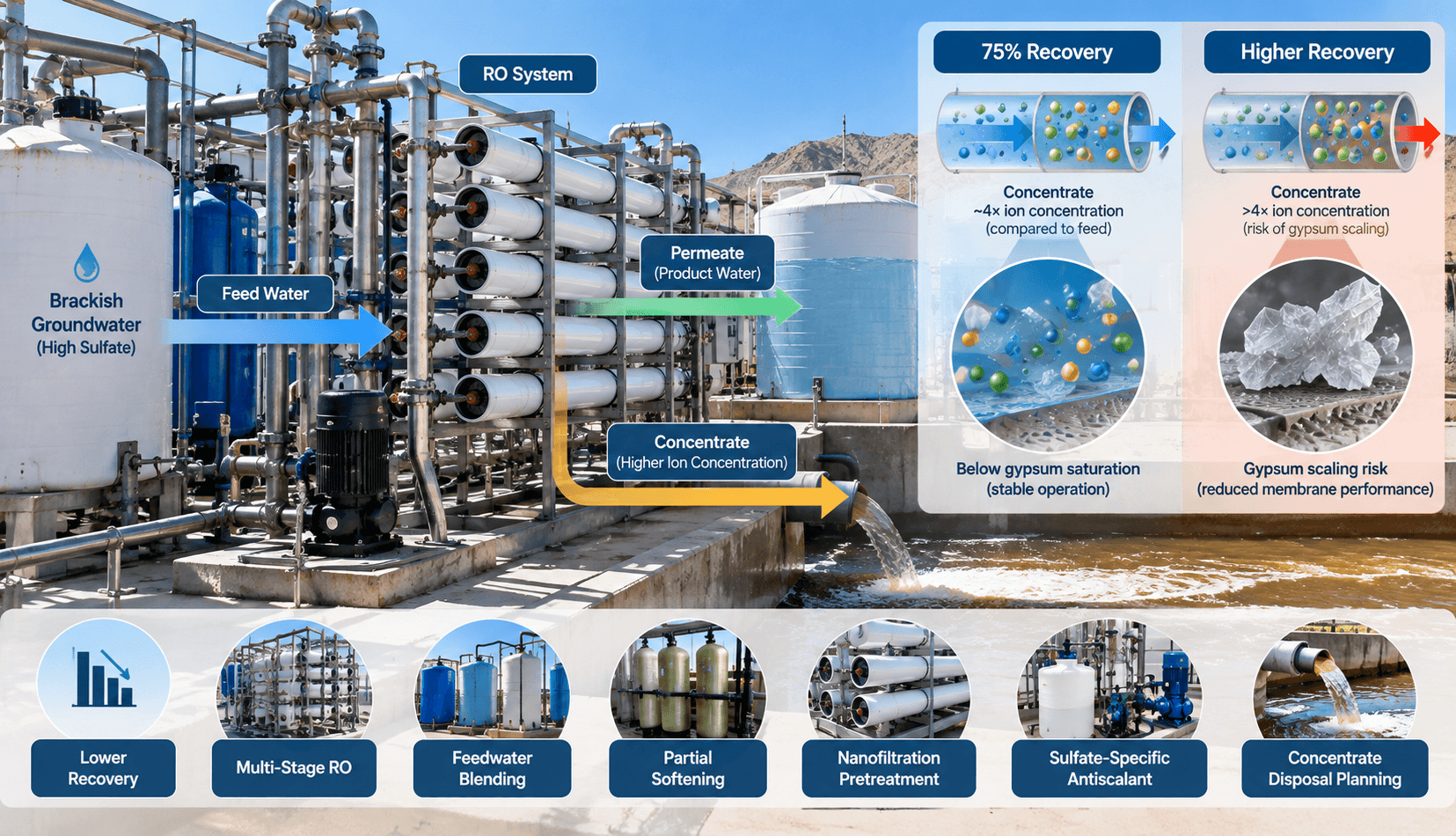
RO recovery rate is the percentage of feedwater converted into permeate. Higher recovery reduces reject-water volume and improves overall water utilization. However, as recovery increases, dissolved ions become more concentrated in the RO concentrate stream.
For example, a system operating at 75% recovery may produce concentrate with approximately four times the feed concentration of many dissolved ions, before considering concentration polarization at the membrane surface. If the groundwater contains high calcium and sulfate, this concentration factor can rapidly push the brine beyond gypsum saturation.
As a result, high-sulfate brackish groundwater may require:
- Lower RO recovery
- Multi-stage RO design with controlled interstage recovery
- Blending of feedwater sources
- Partial softening before RO
- Nanofiltration (NF) pretreatment
- Higher-performance sulfate-specific antiscalant dosing
- More conservative concentrate disposal planning
The right operating recovery is not the highest possible number. It is the highest recovery that can be maintained safely with stable membrane performance, manageable cleaning frequency, and reliable product-water output.
How Specialized Antiscalants Control Sulfate Crystal Formation
A high-quality calcium sulfate scale inhibitor works through several mechanisms. It does not remove calcium or sulfate from water. Instead, it keeps these ions dispersed and delays their precipitation long enough for concentrate to leave the RO system.
Specialized RO membrane antiscalant formulations may provide:
- Threshold inhibition, delaying initial crystal nucleation
- Crystal-growth modification, creating less adherent mineral structures
- Dispersion of fine precipitates before they attach to membranes
- Control of calcium sulfate, barium sulfate, and strontium sulfate supersaturation
- Compatibility with polyamide RO membranes
- Better tolerance of high-temperature or high-TDS conditions
Not all antiscalants provide the same sulfate-scale control. Products formulated mainly for calcium carbonate may have limited performance against barium sulfate or high gypsum saturation. For Kazakhstan’s sulfate-rich groundwater, operators should select a product based on complete water chemistry, projected concentrate composition, operating recovery, temperature, and membrane configuration.
Antiscalant dose should not be determined by guesswork. Both underdosing and overdosing create problems. Underdosing may allow scale to form, while excessive dosing increases chemical cost and can contribute to organic fouling or incompatibility with downstream treatment processes.
When Softening, Nanofiltration, or Lower Recovery Is Necessary
Antiscalants are powerful tools, but they are not unlimited. If the projected concentrate is severely supersaturated with calcium sulfate or contains elevated barium and strontium, pretreatment changes may be required.
Lime or Chemical Softening
Softening reduces calcium and magnesium before RO. This may be appropriate where hardness is very high and sludge handling is practical. Conventional lime softening is particularly useful for carbonate hardness, although sulfate-related hardness may require additional treatment strategies.
Ion Exchange Softening
Sodium-cycle softeners can remove calcium and magnesium effectively, reducing gypsum risk. However, they increase sodium concentration and create brine regeneration waste. This approach may be suitable for moderate flow rates or where very high boiler-water quality is required.
Nanofiltration Pretreatment
Nanofiltration can selectively reject hardness and sulfate while allowing more monovalent salts to pass. In some high-sulfate brackish-water applications, NF before RO can reduce overall scaling risk and allow a more reliable downstream RO operation.
Lower RO Recovery
Reducing recovery is often the simplest immediate response to sulfate scaling risk. It lowers ion concentration in the reject stream and may prevent scale without major capital modifications. The trade-off is higher reject-water volume, so disposal capacity must be assessed.
Build a Better Antiscalant Model Using Concentrate Analysis
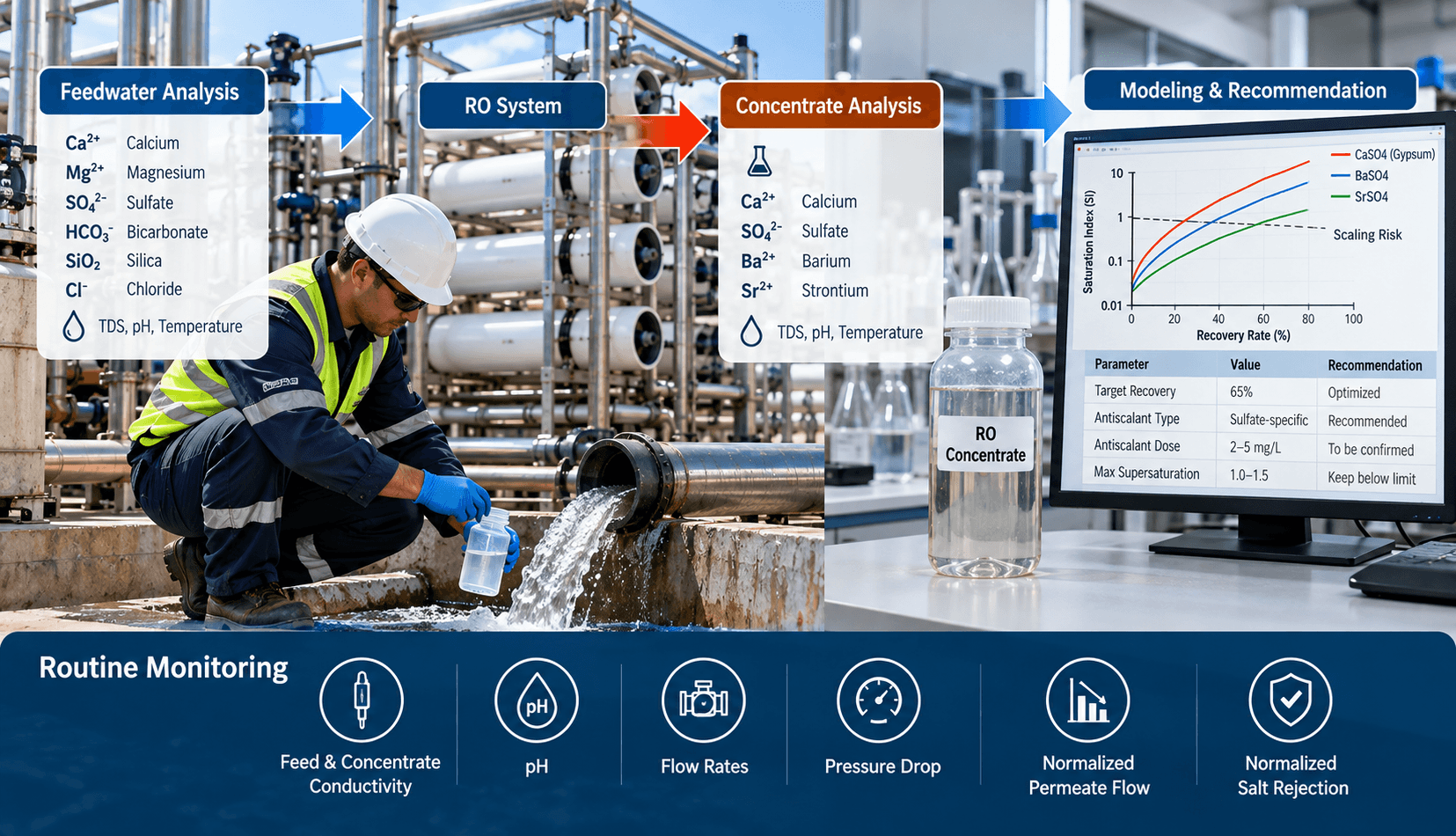
The best RO scale-control program begins with a complete feedwater analysis but should not end there. The critical question is: what does the membrane concentrate look like at the final stage of the RO system?
A reliable model should include:
- Feedwater calcium, magnesium, sulfate, bicarbonate, silica, chloride, and TDS
- Barium and strontium concentrations
- pH, temperature, and seasonal water-quality variation
- RO recovery target and stage configuration
- Membrane type, flux, and concentrate flow rate
- Acid dosing or pH adjustment
- Projected concentrate saturation for calcium sulfate, barium sulfate, and strontium sulfate
- Antiscalant type, dose, and maximum allowable supersaturation
Sampling actual concentrate water is equally important. If concentrate analysis differs significantly from the model, the system may be operating at a higher scaling risk than expected.
Routine monitoring should include feed and concentrate conductivity, pH, flow rates, pressure drop, normalized permeate flow, and normalized salt rejection. These measurements help detect scaling before membrane damage becomes difficult to reverse.
Get High-Sulfate Groundwater RO Scaling Prediction Support
For Kazakhstan industrial projects, preventing sulfate scale requires more than an LSI calculation. It requires complete brackish groundwater chemistry, accurate concentrate projection, and a specialized antiscalant program designed for gypsum, barium sulfate, and strontium sulfate control.
Oneschem provides RO scaling prediction and chemical treatment support for high-sulfate groundwater applications, including RO membrane antiscalant selection, calcium sulfate scale inhibitor recommendations, recovery optimization, and CIP cleaning guidance.
Contact our technical team to request a high-sulfate groundwater RO scaling prediction calculation. Share your complete water analysis, design flow, membrane model, operating temperature, and target recovery, and we will help develop a safer, more reliable RO chemical program for boiler feedwater production.