Fluorosurfactants for AFFF and AR-AFFF Used in Oil Refineries and Tank Farms
ON
Oil refineries, tank farms, fuel depots, petrochemical plants, and marine terminals operate with large volumes of flammable and combustible liquids. A fire involving gasoline, crude oil, jet fuel, diesel, aromatics, alcohol-blended fuels, or chemical feedstocks can spread rapidly across a liquid surface. For these high-hazard sites, firefighting foam concentrates must provide consistent foam generation, stable blankets, and reliable performance under demanding storage and operating conditions.
AFFF and AR-AFFF remain important categories in many existing industrial fire-protection systems, although fluorinated foam products are subject to increasingly strict environmental and regulatory requirements in many jurisdictions. For manufacturers serving refinery and terminal markets, selecting suitable AFFF raw materials—including a compatible fluorosurfactant package—is essential for product quality, storage stability, and finished-foam performance.
Fire Risks in Refineries, Tank Farms and Petrochemical Complexes
Refineries and tank farms contain many potential ignition sources and fuel hazards. These may include storage tanks, loading racks, pipeline systems, pump stations, blending areas, separator units, process vessels, truck-loading facilities, and marine transfer terminals.
Typical fire scenarios include:
- Full-surface or rim-seal storage tank fires
- Spill fires around pumps, manifolds, and loading areas
- Bund or dike fires following tank leakage
- Jet fires from pressurized hydrocarbon releases
- Pool fires involving gasoline, crude oil, naphtha, jet fuel, or diesel
- Fires involving alcohol-blended gasoline or polar solvents
These incidents can expose foam concentrates to challenging conditions: high temperatures, long discharge distances, hard water, seawater, elevated salinity, and specialized proportioning systems. Foam performance must therefore be evaluated based on the actual fuel type, equipment design, water quality, and applicable fire-protection standard.
Why Fast Spreading and Vapor Suppression Are Essential
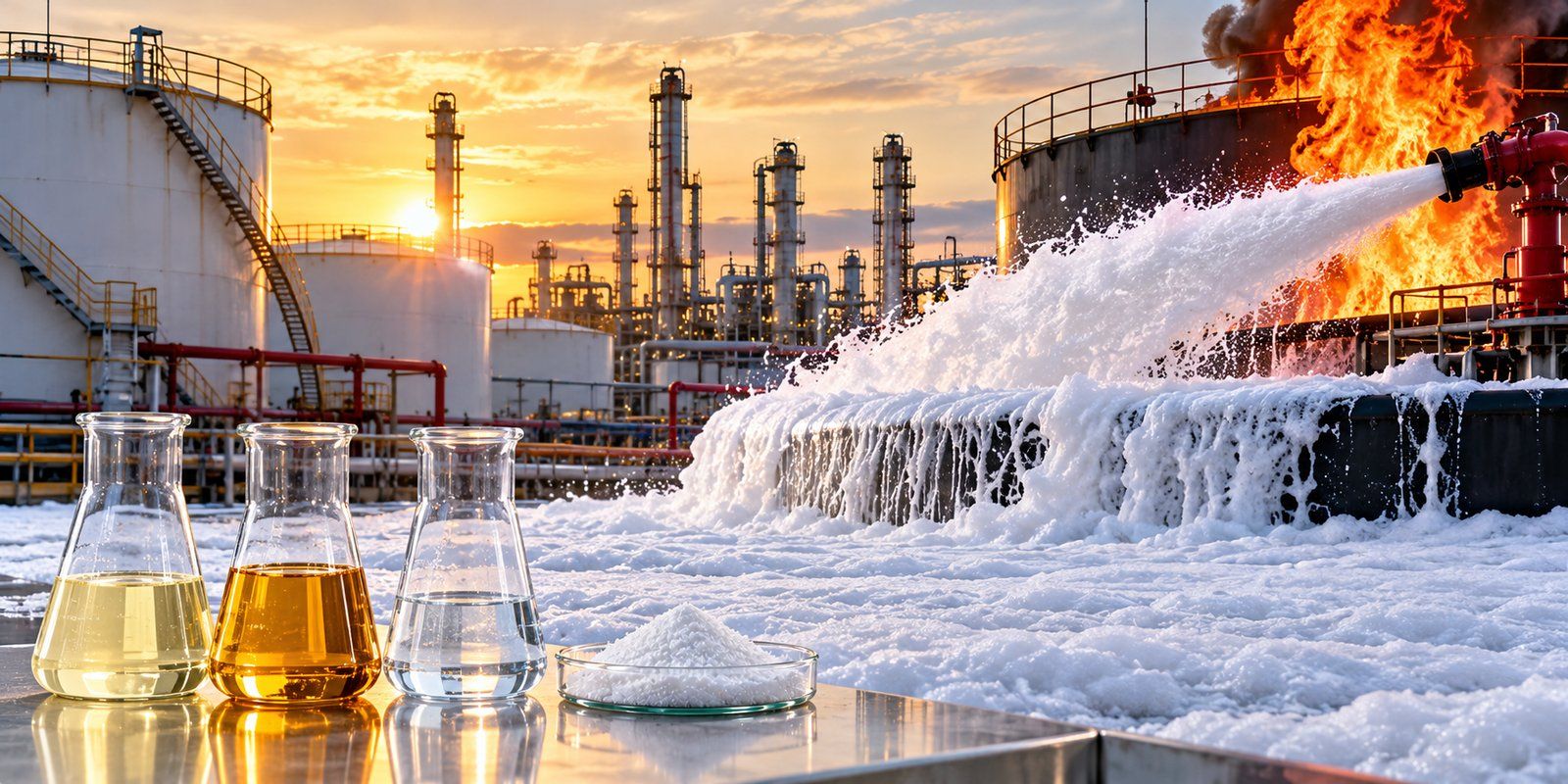
When a foam blanket is applied to a flammable liquid fire, its primary functions include cooling, separating the fuel surface from oxygen, reducing radiant heat exposure, and suppressing flammable vapors from the fuel surface.
For hydrocarbon liquids, rapid spreading can be especially important. A uniform foam layer helps cover exposed fuel quickly and may reduce the chance of reignition when maintained effectively. In refinery and tank-farm applications, foam may need to travel across large fuel surfaces or withstand challenging application conditions such as wind, heat, fuel turbulence, and long discharge distances.
The finished foam concentrate must therefore deliver a suitable balance of:
- Foam expansion
- Drainage time
- Bubble structure
- Flow and spreading behavior
- Fuel shedding properties
- Heat resistance
- Post-fire security and burnback resistance
No single raw material delivers all of these properties. Successful AFFF and AR-AFFF formulations depend on the interaction of fluorosurfactants, hydrocarbon surfactants, solvents, foam stabilizers, polymers, salts, corrosion inhibitors, preservatives, and water quality.
The Role of Fluorosurfactants in Film-Forming Foam Concentrates
A fluorosurfactant for oil refinery firefighting foam is used to reduce the surface tension of the diluted foam solution and help support rapid wetting and spreading characteristics on suitable hydrocarbon fuels. In traditional AFFF formulations, fluorinated surfactants can contribute to the formation of an aqueous film under specific fuel and application conditions.
The fluorosurfactant works alongside the hydrocarbon surfactant package. Hydrocarbon surfactants generally support foam generation, bubble formation, and foam stability, while the fluorosurfactant contributes low surface tension and fuel-surface behavior.
When evaluating a fluorosurfactant for AFFF production, manufacturers should consider:
- Compatibility with anionic, amphoteric, and nonionic co-surfactants
- Surface tension at the intended use concentration
- Solubility and clarity in the finished concentrate
- Stability during long-term storage
- Heat-aging performance
- Compatibility with hard water, brackish water, or seawater
- Influence on foam expansion and drainage time
- Batch-to-batch consistency
- Regulatory status in intended sales markets
It is important to test the fluorosurfactant in the complete formulation. Low surface tension in a simple laboratory solution does not automatically confirm performance in a finished foam concentrate.
Key Differences Between AFFF and AR-AFFF Raw Material Requirements
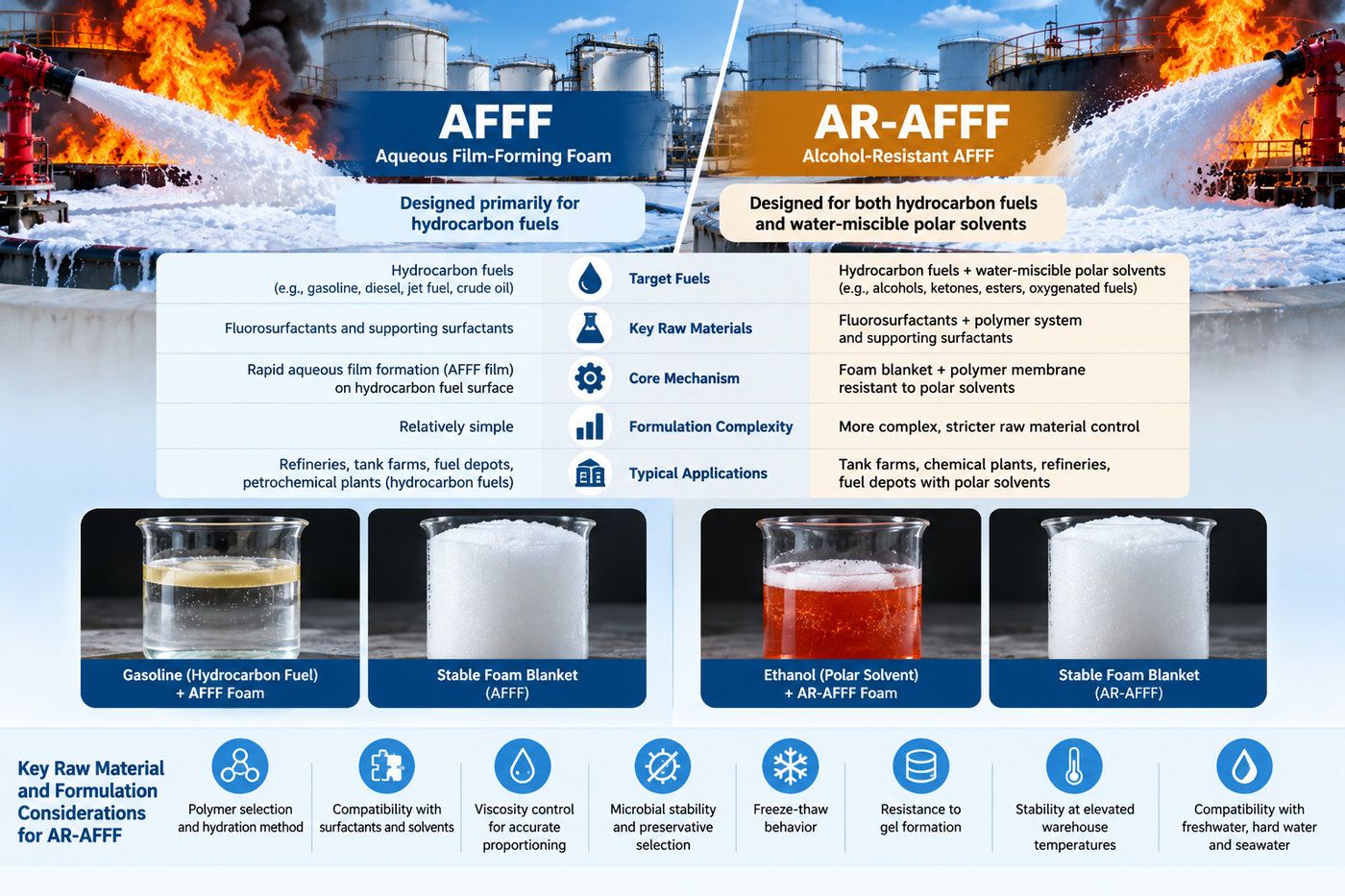
AFFF is generally designed primarily for hydrocarbon fuels such as gasoline, diesel, jet fuel, crude oil, and many petroleum products. AR-AFFF, or alcohol-resistant aqueous film-forming foam, is designed to address both hydrocarbon fuels and water-miscible polar solvents such as alcohols, ketones, esters, and certain oxygenated fuels.
The main difference is that AR-AFFF requires a polymer system capable of creating a protective membrane or barrier when foam contacts a polar solvent. Without this barrier, a water-miscible fuel can destroy conventional foam rapidly by extracting water from the bubbles.
As a result, AR-AFFF for tank farms often requires more complex raw material control than standard AFFF. Key formulation considerations may include:
- Polymer selection and hydration method
- Polymer compatibility with surfactants and solvents
- Viscosity control for accurate proportioning
- Microbial stability and preservative selection
- Freeze-thaw behavior where relevant
- Resistance to gel formation during storage
- Stability at elevated warehouse temperatures
- Compatibility with freshwater, hard water, and seawater
AR-AFFF concentrates must also be evaluated at the intended application rate and according to the fuel types for which the product is marketed.
Improving Foam Blanket Stability on Hydrocarbon Fuels
A stable foam blanket is critical for hydrocarbon fire control and post-fire security. Poor blanket stability can lead to faster drainage, inadequate coverage, vapor release, or increased reignition risk.
To improve foam stability, manufacturers should optimize the overall surfactant package rather than simply increasing active surfactant content. Excess surfactant can sometimes cause unwanted viscosity changes, reduced foam quality, or storage instability.
Important formulation factors include:
- Correct fluorosurfactant-to-hydrocarbon surfactant balance
- Controlled electrolyte levels
- Stable pH range
- Appropriate solvent and hydrotrope selection
- Use of compatible foam stabilizers
- Low hardness process water during production
- Controlled mixing order and batch temperature
- Heat-aging verification before commercialization
Testing should include foam expansion, 25% drainage time, appearance, viscosity, surface tension, dilution clarity, and fuel-specific fire-performance evaluation where required.
Batch Consistency Requirements for Large Industrial Foam Projects
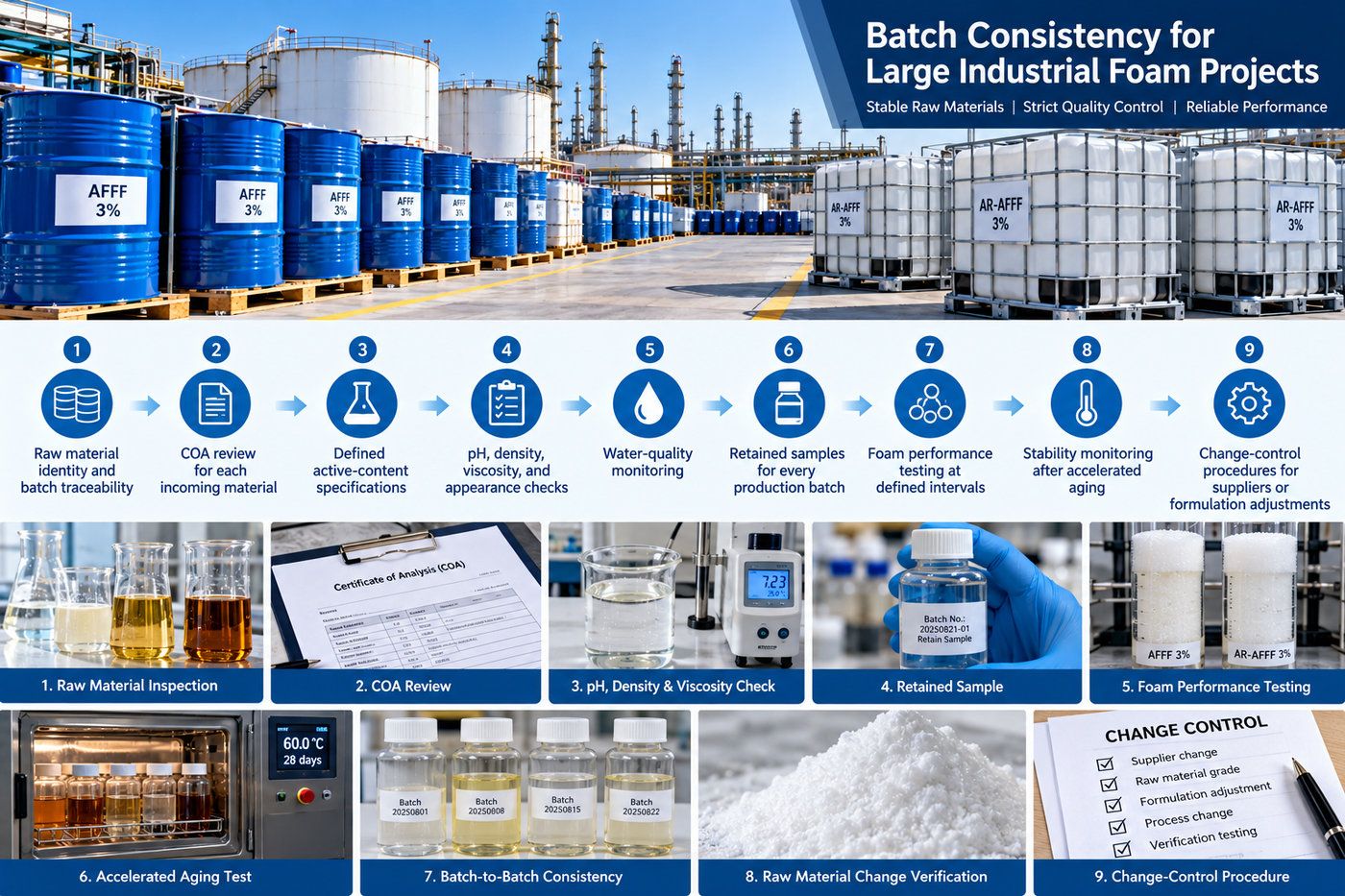
Large refinery and tank-farm projects may require hundreds of drums, IBCs, or bulk deliveries of foam concentrate. Inconsistent raw materials can create significant project risk, especially when foam concentrate is produced over multiple batches or supplied across several years.
Manufacturers should implement a documented quality-control system that includes:
- Raw material identity and batch traceability
- COA review for each incoming material
- Defined active-content specifications
- pH, density, viscosity, and appearance checks
- Water-quality monitoring
- Retained samples for every production batch
- Foam performance testing at defined intervals
- Stability monitoring after accelerated aging
- Change-control procedures for suppliers or formulation adjustments
Any change in fluorosurfactant source, solvent grade, surfactant active content, polymer grade, or process water quality should trigger formulation verification.
Choosing a Fluorosurfactant Supplier for Long-Term Production
A qualified fluorosurfactant supplier should provide more than a competitive price. For long-term AFFF and AR-AFFF manufacturing, suppliers should offer consistent product specifications, reliable documentation, stable lead times, export-ready packaging, and technical communication.
Before qualification, request:
- Technical Data Sheet (TDS)
- Safety Data Sheet (SDS)
- Certificate of Analysis (COA)
- Recommended storage conditions and shelf-life information
- Regulatory and market-specific documentation
- Sample material for formulation and aging trials
Because fluorinated chemistry regulations are evolving globally, foam manufacturers should verify applicable requirements in every target market before selecting materials or making product claims.
ONESCHEM supports foam manufacturers with fluorosurfactant solutions for AFFF and AR-AFFF development. Contact our technical team to request samples, TDS, SDS, COA, or technical support for refinery, terminal, and tank-farm foam concentrate formulations.