
Direct Lithium Extraction Water Treatment in Argentina: Antiscalants and Membrane Cleaning for High-Boron Brines
ON
In Argentina’s Puna region—spanning the high-altitude salars of Jujuy, Salta, and Catamarca—lithium extraction is undergoing a major technological shift. Operators are moving beyond traditional multi-year solar evaporation ponds toward Direct Lithium Extraction (DLE) and hybrid hydrometallurgical processing.
While DLE dramatically reduces extraction time from months to hours and improves lithium yield, it creates an intense operational demand for water management. Stripping reagents, column washing, eluent production, and spent-brine conditioning generate complex aqueous streams that must be treated, concentrated, and recycled.
Membrane separation technologies, including high-pressure reverse osmosis (HPRO), brackish water RO, and nanofiltration (NF), are central to these circuits. However, the extreme ionic strength of Argentine salar waters—characterized by elevated boron, reactive silica, calcium, magnesium, and variable sulfate—places extreme thermal, osmotic, and scaling stress on membrane installations.
Operating reliable lithium brine water treatment in Argentina requires moving beyond conventional water treatment programs to specialized RO membrane antiscalant chemistry and targeted membrane cleaning chemicals.
Why DLE and Salar Projects Require Resilient Water Recovery
Freshwater availability in the high-altitude Andean plateau is exceptionally limited. Environmental regulations, community water pacts, and water-use concessions require DLE developers to maximize process water recycling.
In a typical DLE flowsheet, water is consumed during:
- Desorption of lithium from adsorption media or ion-exchange resins
- Eluate concentration and impurity scrubbing
- Re-injection conditioning of spent brine to maintain reservoir equilibria
- Off-gas scrubbing and lime slaking
Recovering water from these streams requires membrane systems to operate at high osmotic pressures while maintaining structural membrane integrity. If membranes scale or foul, plant water recovery plummets, fresh make-up water consumption breaches permitted limits, and high-value lithium can be lost in premature purge streams. Reliable DLE process water reuse chemicals are therefore a core operational requirement, not an afterthought.
The Multi-Fouling Challenge: High Salinity, Boron, and Silica
Treating spent brines and process wash waters simultaneously exposes membranes to multiple competing scaling and fouling mechanisms:
1. Boron Speciation and Osmotic Limits
At standard ambient and slightly acidic to neutral pH (pH 6.0–7.5), boron exists predominantly as uncharged, monomeric boric acid (B(OH)3). Because of its small molecular dimensions and lack of electrostatic charge, boric acid readily passes through conventional polyamide RO membranes, yielding poor rejection (40%–70%).
To force boron into the negatively charged borate anion (B(OH)4−) for >95% rejection, plants often elevate feedwater pH above 9.5–10.5. However, this alkaline shift immediately pushes hardness and silica past their thermodynamic saturation limits.
2. Silica Polymerization and Silicate Scale
Groundwater and brine streams across the Argentine volcanic plateau frequently carry reactive silica concentrations exceeding 50–120 mg/L. At lower pH, silica polymerizes into colloidal gels that coat feed channels. At high pH, silica reacts with magnesium, calcium, and aluminum to form insoluble silicate scales that resist standard chemical dissolution.
3. High Ionic Strength and Ion Pairing
Total dissolved solids (TDS) in these streams frequently range from 30,000 mg/L to well over 100,000 mg/L. Under extreme ionic strength, standard activity coefficients no longer apply, and ion pairing shifts saturation dynamics unexpectedly. The risk of high boron RO scaling is rarely a single-mineral event; it is almost always a co-precipitate of metal borates, silicates, and carbonates.
Why Conventional Antiscalants Fail in High-TDS Brines
Standard water treatment facilities often rely on general-purpose polyacrylic acid (PAA) or basic phosphonate formulations (such as ATMP or HEDP). In high-salinity lithium brines, these products encounter distinct failure modes:
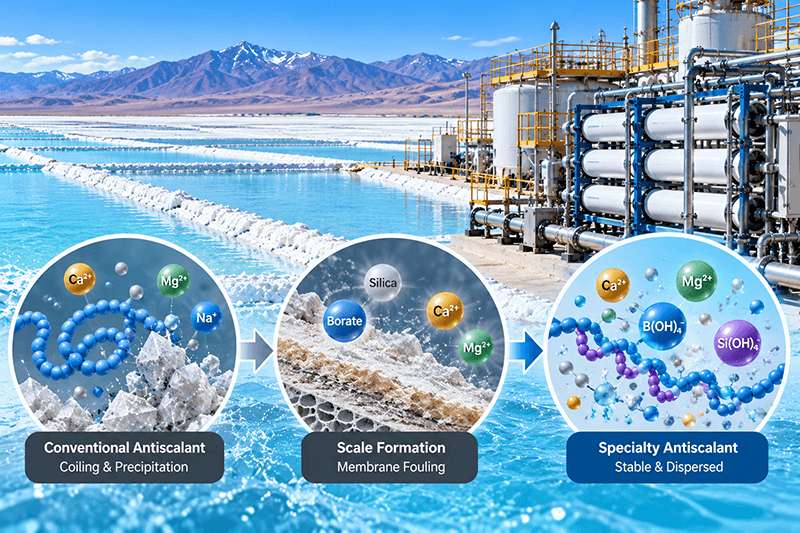
- Charge Neutralization and Coiling: Extreme background salinity shields the electrostatic repulsion along the polymer chain, causing polyacrylate molecules to collapse into tight coils. This destroys their surface-active threshold inhibition capability.
- Polymer-Cation Precipitation: In the presence of high calcium and magnesium, conventional phosphonates and high-molecular-weight polyacrylates precipitate as insoluble calcium-phosphonate or calcium-polyacrylate gels, worsening feed-spacer fouling.
- Ineffective Borate/Silica Dispersion: Standard chemistries offer limited functional control over borate-silicate complexes, allowing amorphous silicate matrices to incorporate borate and bond tightly to polyamide membrane surfaces.
Formulating Specialty Antiscalants Through Ion Speciation Modeling
Selecting an RO membrane antiscalant for Argentine DLE circuits requires geochemical modeling calibrated with the Pitzer ion-interaction model rather than the standard Debye-Hückel approach or simple Langelier Saturation Index (LSI) values.
High-performance chemistries for this service feature:
- Low-Molecular-Weight, Salt-Tolerant Terpolymers: Polymers engineered with sulfonated and non-ionic functional groups that maintain active molecular conformation even at TDS>100,000 mg/L.
- High Calcium Tolerance: Formulations that remain soluble and chemically active in brine backgrounds containing thousands of milligrams per liter of Ca2+ and Mg2+.
- Synergistic Silica/Silicate Dispersion: Targeted active ingredients that delay the induction time of silica polymerization and disrupt the crystal lattices of magnesium and calcium silicates.
Accurate dosing must be governed by dynamic brine analytics, accounting for daily fluctuations in eluate composition, pH spikes, and temperature drops typical of the Puna plateau.
Acid vs. Alkaline Cleaning: Tackling Complex Composite Foulants
When managing multi-component deposits in lithium circuits, Clean-In-Place (CIP) programs must employ specialized membrane cleaning chemicals applied in a strict, engineered sequence.
Composite Brine Foulants
├── Inorganic Scale (Carbonates, Gypsum, Iron) ──> Low-pH Acid Clean (pH 2.0–3.0)
└── Silica, Borates, Organic Extractants, Clays ──> High-pH Alkaline Clean (pH 10.5–11.5)
The Low-pH Acid Wash (pH 2.0–3.0)
Acid cleaners formulated with organic acids and specialized chelants dissolve acid-soluble carbonates, iron oxides, and liberate co-precipitated metal cations. However, acid cleaning will not dissolve amorphous silica; in fact, exposing high-silica feeds to unbuffered acid can accelerate silica polymerization on the membrane surface.
The High-pH Alkaline Wash (pH 10.5–11.5)
High-pH cleaners containing optimized surfactants, builders, and organic dispersants are critical for hydrolyzing biological matter, stripping organic extraction solvent carryover, and solubilizing colloidal silica and borate complexes. Temperature control is critical: heating the cleaning solution to the membrane manufacturer's upper limit (typically 35∘C–45∘C) dramatically accelerates silica dissolution kinetics.
Crucial Sequence Rule: If the foulant matrix contains high organic or extraction-reagent residues alongside scale, an alkaline clean must precede the acid wash. Introducing acid to organic-laden membranes can cross-link or coagulate organic species into a permanent foulant layer.
Mitigating Salt Re-Precipitation and Concentrate Line Plugging
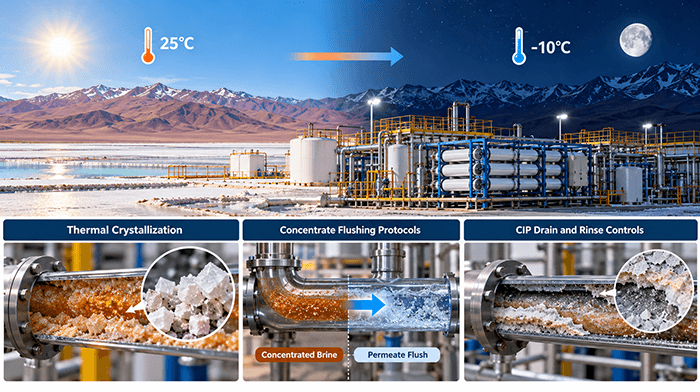
The high-altitude Andean environment presents steep diurnal temperature swings: daytime temperatures can reach 25∘, plunging below −10∘C at night. This severe cooling represents an operational risk for concentrated brine circuits:
- Thermal Crystallization: Saturated salts (particularly sodium sulfate, borates, and halite) that remain stable at daytime processing temperatures rapidly precipitate as brine lines and pressure vessels cool during shutdowns.
- Concentrate Flushing Protocols: RO trains must never be shut down while filled with active brine. Automated displacement protocols using high-quality permeate must displace concentrated brine within minutes of an unplanned trip or scheduled shutdown.
- CIP Drain and Rinse Controls: Cleaning solutions loaded with dissolved foulants must be displaced using warm, low-hardness rinse water. Cold, hard flush water can shock the cleaning fluid, causing dissolved silicates or carbonates to crash out inside concentrate piping and spacer channels.
Request a High-Salinity Brine Membrane Feasibility Assessment
Operating high-recovery membrane systems on Argentine lithium brines requires precise chemical engineering that accounts for elevated TDS, high boron, reactive silica, and harsh high-altitude conditions.
Oneschem provides tailored RO membrane antiscalant programs, specialty membrane cleaning chemicals, and geochemical scaling modeling for DLE and lithium brine operations across Jujuy, Salta, and Catamarca.
Contact our technical team to request an engineering assessment of your brine chemistry. Provide your ionic profile (Li, B, Si, Ca, Mg, SO4, Cl, TDS), operating recovery targets, and process pH, and our application specialists will deliver a customized scaling prediction and chemical treatment recommendation for your facility.